Make: Apex Innovations
Model: 240
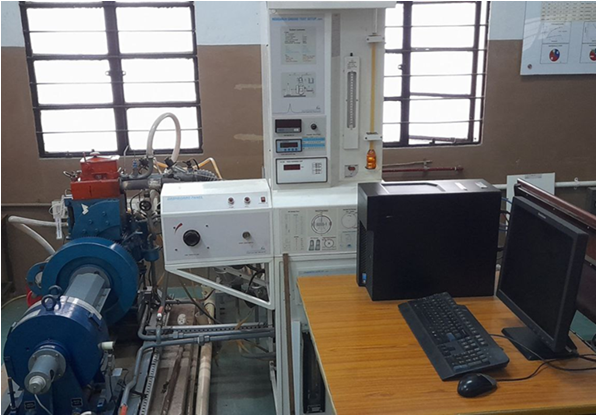
Specification
|
Make Kirloskar, Single cylinder, 4 stroke, water cooled, stroke 110 mm, bore 87.5 mm, 661 cc. Power 3.5 KW @ 1500 rpm, CR range 12-18. | |
| ECU | Programmable open ECU with necessary wiring harness, MAP/MAPT, Pressure control valve, Rail pressure control/FDP, Fuel pump and main relay control, Peak And hold low impedance Injector, EGT, CLT, custom sensor, effective APP control | |
| EGR | Watercooled,SS304,Range0-15% | |
| Injector | Type Solenoid driven | |
| Piezo sensor | Combustion: Range 350 Bar with low noise cable | |
| Crank angle sensor | Resolution1Deg, Speed 5500RPM with TDC pulse. | |
| Data acquisition device | Analog inputs: 16 SE/8 DIFF; Digital I/O: 8; Analog outputs: up to 2; counters 2 x 32 bit; Sample rate: 250 kS/s; Resolution: 16- bit; Analog input Vmax ±10V of AI GND; High speed multifunction USB DAQ card | |
| Temperature sensor | TypeRTD,PT100andThermocouple,TypeK,Range0-1200DegC | |
| Temperature transmitter | Type 2 wire, Input RTD PT100, Range 0-100 Deg C, Output 4-20 mA and Type 2 wire, Input Thermocouple, Range 0-1200 Deg C | |
| Load Sensor indicator | Load cell, type strain gauge, range 0-50Kg Digital, Range0-50Kg, | |
| Fuel flow transmitter | DPtransmitter,Range0-500mm WC | |
| Airflow transmitter | Pressure transmitter, Range(-)250mmWC | |
| Rota meter | Engine cooling 40-400 LPH, Calorimeter 25-250 LPH |
The origination of the idea of variable compression ratio was the desire to use it for the engine supplying fuels with different properties; it is the so-called flex-fuel Capability.
The development of VCR technology says something about the potential for reducing fuel consumption.
The VCR technology enables a significant extension of the “downsizing” range, allowing further reduction of the displacement volume and the use of even higher boosting pressures. It is estimated that this method of adjusting the working parameters of the spark-ignition engine can result in a reduction in the fuel consumption by up to 30% without a significant increase of toxic exhaust compound emission.
VCR technology is the possibility of effective implementation of advanced, low-temperature LTC combustion processes (low-temperature combustion). They are characterized by extremely low emission levels of toxic compounds as a result of high complementarily of the combustion phase but conducted under conditions with reduced charge temperature.
Ground floor
GD Naidu block,
Thermal Engineering System Lab
School of Mechanical Engineering
Professor Grade 2,
School of Mechanical Engineering,
VIT, Vellore, TN-632014.
Email: vincent.wilson@vit.ac.in | Thermalengineeringg11@gmail.com
Phone: +91-416-220 2227
| User Type | Charges (INR) (+ applicable GST) |
|---|---|
| Internal-UG /PG Students from Academic Institution | NIL |
| Internal-Research Scholar from Academic Institution | NIL |
| Internal-Faculty Members /Project Staff from Academic Institution | NIL |
| External-UG /PG Students from Academic Institution | 2200 |
| External-Research Scholar from Academic Institution | 2200 |
| External-Project Staff from Academic Institution | 2200 |
| External-Faculty Members from Academic Institution | 2200 |
| External-Research Scientist from R&D Organizations | 2200 |
| External-Industry Personnel from Industry | 2200 |
| External-Personnel from Non - Government Organization | 2200 |